
Your First Online Beginner Lesson for Piano – Left Hand
 In our first beginner lesson for piano, we were introduced to the Middle C Position (First Position) for the right hand.
We also learned two fundamental fingering styles that are often used while playing the piano.
But as with any physical exercise, you can’t just work one bicep without working the other.
Welcome to Get Piano Lesson 2, where we’ll continue our beginner lessons for piano by teaching our left hand what our right hand already knows…
Left Hand
First let’s find Middle C again. Got it? This time since we’ll be working the left hand we’re going to use the C note that is seven notes to the left of Middle C. Right, that’s the next C note down from Middle C.
Great, this time place your left number 5 finger (pinky) on the C note. Now place your left ring finger (number 4) on the white note to the right of C.
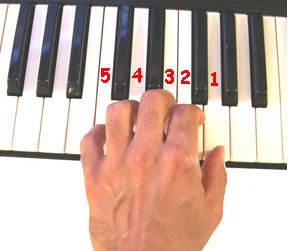 Next, place your remaining left three fingers down on the next three white keys respectively.
You should have all five of your left fingers resting on the white keys, this time with your little finger starting on C.
Keep your wrist up and your fingers curved.
Compare your hand position to my hand position in this chart.
Because we have all our fingers in one position, starting at C, we will call this: “Position Number 1”.
Chalkboard Assignment
As we play this beginner lesson for piano, keep each finger glued to its’ properly assigned key and play the following finger pattern one finger at a time:
Let’s see if this hand is easier or more difficult for you?
 Again, be sure not to press more than one note down at a time, releasing each note before pressing the next one down.
Keep your hand steady and in one place.
As in our previous beginner lesson for piano, remember to pay special attention to fingers 3 and 4 as you play them.
Notice if you have any difficulty playing these fingers evenly, because they’re probably not accustomed to working independently.
Legato

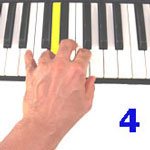


Focus on playing the left hand finger pattern in a smooth “legato” style. One note should follow the other evenly, with no space in between them and with equal volume for each note.
Also notice how my hand stays in the same position and shape as I play all 5 notes.
Your goal in this exercise is to play this 5-note sequence slowly at first.
Then increase your speed only when you feel you’ve gotten the hang of it. Be sure you’re playing the notes smoothly, accurately and evenly.
Better Yet… Sit Back, Relax and Watch Me
Demonstrate This Basic Legato Playing Style!
Staccato
Now we’re going to force those left hand fingers to work independently of one another by playing them each with short detached bursts (staccato).
For this beginner lesson for piano, we’re playing the same 5-note finger pattern as before:
 Use control to pace yourself as you quickly strike and release each finger on and off its’ properly assigned key.
Play the sequence of notes slowly at first. When you feel ready, try playing the pattern faster, but be careful not to tense up. Stay relaxed.
While playing the staccato exercise with more speed, it’s okay to slightly bounce your hand up and down. This may give you more leverage to strike down on and pull back from the keys.
Remember, in this part of our beginner lesson for piano, it’s okay to slightly bounce your hand up and down as you play the keys in a faster “staccato” motion.
Just be sure you’re bouncing from your wrist and not your forearm. A slight bounce in your hand will give you better leverage to strike down and pull back off the keys while playing “staccato” at faster speeds.
What’s that? You’d rather see me do it?
No Problem… Just Sit Back and Watch Me Show
You How This Staccato Fingering Method is Played!
Congratulations! You’ve just completed your first left-handed beginner lesson for piano. Be sure to practice Get Piano Lesson 1 and 2 until you can play them smoothly and accurately in both hands.
When you’re comfortable with this material and you’re ready for more, just click ahead on to your next beginner lesson for piano…
Your First Online Beginner Lesson for Piano – Left Hand
 In our first beginner lesson for piano, we were introduced to the Middle C Position (First Position) for the right hand.
We also learned two fundamental fingering styles that are often used while playing the piano.
But as with any physical exercise, you can’t just work one bicep without working the other.
Welcome to Get Piano Lesson 2, where we’ll continue our beginner lessons for piano by teaching our left hand what our right hand already knows…
Left Hand
First let’s find Middle C again. Got it? This time since we’ll be working the left hand we’re going to use the C note that is seven notes to the left of Middle C. Right, that’s the next C note down from Middle C.
Great, this time place your left number 5 finger (pinky) on the C note. Now place your left ring finger (number 4) on the white note to the right of C.
Next, place your remaining left three fingers down on the next three white keys respectively.
You should have all five of your left fingers resting on the white keys, this time with your little finger starting on C.
Keep your wrist up and your fingers curved.
Compare your hand position to my hand position in this chart.
Because we have all our fingers in one position, starting at C, we will call this: “Position Number 1”.
Chalkboard Assignment
As we play this beginner lesson for piano, keep each finger glued to its’ properly assigned key and play the following finger pattern one finger at a time:
Let’s see if this hand is easier or more difficult for you?
Again, be sure not to press more than one note down at a time, releasing each note before pressing the next one down.
Keep your hand steady and in one place.
As in our previous beginner lesson for piano, remember to pay special attention to fingers 3 and 4 as you play them.
Notice if you have any difficulty playing these fingers evenly, because they’re probably not accustomed to working independently.
Legato
Focus on playing the left hand finger pattern in a smooth “legato” style. One note should follow the other evenly, with no space in between them and with equal volume for each note.
Also notice how my hand stays in the same position and shape as I play all 5 notes.
Your goal in this exercise is to play this 5-note sequence slowly at first.
Then increase your speed only when you feel you’ve gotten the hang of it. Be sure you’re playing the notes smoothly, accurately and evenly.
Better Yet… Sit Back, Relax and Watch Me
Demonstrate This Basic Legato Playing Style!
Staccato
Now we’re going to force those left hand fingers to work independently of one another by playing them each with short detached bursts (staccato).
For this beginner lesson for piano, we’re playing the same 5-note finger pattern as before:
Use control to pace yourself as you quickly strike and release each finger on and off its’ properly assigned key.
Play the sequence of notes slowly at first. When you feel ready, try playing the pattern faster, but be careful not to tense up. Stay relaxed.
While playing the staccato exercise with more speed, it’s okay to slightly bounce your hand up and down. This may give you more leverage to strike down on and pull back from the keys.
Remember, in this part of our beginner lesson for piano, it’s okay to slightly bounce your hand up and down as you play the keys in a faster “staccato” motion.
Just be sure you’re bouncing from your wrist and not your forearm. A slight bounce in your hand will give you better leverage to strike down and pull back off the keys while playing “staccato” at faster speeds.
What’s that? You’d rather see me do it?
No Problem… Just Sit Back and Watch Me Show
You How This Staccato Fingering Method is Played!
Congratulations! You’ve just completed your first left-handed beginner lesson for piano. Be sure to practice Get Piano Lesson 1 and 2 until you can play them smoothly and accurately in both hands.
When you’re comfortable with this material and you’re ready for more, just click ahead on to your next beginner lesson for piano…
Your First Online Beginner Lesson for Piano – Left Hand
In our first beginner lesson for piano, we were introduced to the Middle C Position (First Position) for the right hand.
We also learned two fundamental fingering styles that are often used while playing the piano.
But as with any physical exercise, you can’t just work one bicep without working the other.
Welcome to Get Piano Lesson 2, where we’ll continue our beginner lessons for piano by teaching our left hand what our right hand already knows…
Left Hand
First let’s find Middle C again. Got it? This time since we’ll be working the left hand we’re going to use the C note that is seven notes to the left of Middle C. Right, that’s the next C note down from Middle C.
Great, this time place your left number 5 finger (pinky) on the C note. Now place your left ring finger (number 4) on the white note to the right of C.
Next, place your remaining left three fingers down on the next three white keys respectively.
You should have all five of your left fingers resting on the white keys, this time with your little finger starting on C.
Keep your wrist up and your fingers curved.
Compare your hand position to my hand position in this chart.
Because we have all our fingers in one position, starting at C, we will call this: “Position Number 1”.
Chalkboard Assignment
As we play this beginner lesson for piano, keep each finger glued to its’ properly assigned key and play the following finger pattern one finger at a time:
Let’s see if this hand is easier or more difficult for you?
Again, be sure not to press more than one note down at a time, releasing each note before pressing the next one down.
Keep your hand steady and in one place.
As in our previous beginner lesson for piano, remember to pay special attention to fingers 3 and 4 as you play them.
Notice if you have any difficulty playing these fingers evenly, because they’re probably not accustomed to working independently.
Legato
Focus on playing the left hand finger pattern in a smooth “legato” style. One note should follow the other evenly, with no space in between them and with equal volume for each note.
Also notice how my hand stays in the same position and shape as I play all 5 notes.
Your goal in this exercise is to play this 5-note sequence slowly at first.
Then increase your speed only when you feel you’ve gotten the hang of it. Be sure you’re playing the notes smoothly, accurately and evenly.
Better Yet, Sit Back, Relax and Watch Me Demonstrate This Basic Legato Playing Style!
Staccato
Now we’re going to force those left hand fingers to work independently of one another by playing them each with short detached bursts (staccato).
For this beginner lesson for piano, we’re playing the same 5-note finger pattern as before:
Use control to pace yourself as you quickly strike and release each finger on and off its’ properly assigned key.
Play the sequence of notes slowly at first. When you feel ready, try playing the pattern faster, but be careful not to tense up. Stay relaxed.
While playing the staccato exercise with more speed, it’s okay to slightly bounce your hand up and down.
This may give you more leverage to strike down on and pull back from the keys.
Remember, in this part of our beginner lesson for piano, it’s okay to slightly bounce your hand up and down as you play the keys in a faster “staccato” motion.
Just be sure you’re bouncing from your wrist and not your forearm.
A slight bounce in your hand will give you better leverage to strike down and pull back off the keys while playing “staccato” at faster speeds.
What’s that? You’d rather see me do it?
No Problem… Just Sit Back and Watch Me Show You How This Staccato Fingering Method is Played!
Congratulations! You’ve just completed your first left-handed beginner lesson for piano. Be sure to practice Get Piano Lesson 1 and 2 until you can play them smoothly and accurately in both hands.
When you’re comfortable with this material and you’re ready for more, just click ahead on to your next beginner lesson for piano…